EN:
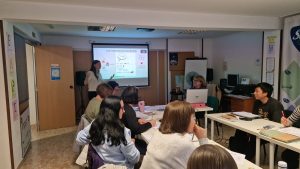
At our Ser Joven office, on 21 October 2026, we held our third activity as part of our local initiatives, dedicated to poetry. This time, we did something that might seem impossible at first glance, but which really isn’t: the students on the beginner’s course in Spanish as a Foreign Language managed to write poetry.
The activity focused on the haiku, and we explored vocabulary related to this poetic form, particularly that linked to the four seasons, the five senses and emotions. The participants learnt a great deal of new vocabulary and also read various original haikus adapted to their level of Spanish.
We incorporated a bit of drama too: participants read the poems whilst expressing one of the emotions from the vocabulary we’d covered, and the others had to guess which one it was. They then wrote their own haikus using the following structure:
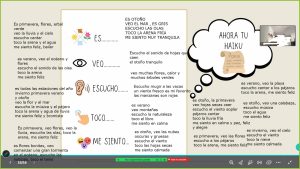
It’s (name of the season) I see… I hear… I touch… I feel…
Here are a few examples, whilst we await the publication in a few months’ time of the Multilingual Anthology of Poems, which will bring together the poems of participants from other countries:
“It’s autumn, I see a pumpkin
I hear music
I touch the water
I feel happy”
“It’s all the seasons of the year
winter, spring, summer
and autumn
I see the flower and the sea
I hear the music and the bird
I touch the sand and the rainwater
I feel happy and playful”
ES:
En nuestra oficina de Ser Joven, el día 21 de octubre de 2026, tuvimos una tercera actividad dentro de las acciones locales, dedicada a la poesía. Esta vez hemos hecho algo que a primera vista puede parecer imposible, pero que realmente no lo es: las y los estudiantes de Español como Lengua Extranjera del curso inicial han conseguido escribir poesía.
La actividad se centró en el haiku y exploramos el vocabulario relacionado con esta forma poética, sobre todo el conectado con las cuatro estaciones del año, los cinco sentidos y las emociones. Las personas participantes pudieron aprender mucho vocabulario nuevo y, además, leer diferentes haikus originales y adaptados a su nivel de español.
Usamos un poco de teatro también: las personas participantes leían los poemas utilizando una de las emociones del vocabulario trabajado, y las demás tenían que adivinar de cuál se trataba. Luego, ellas mismas escribieron sus haikus utilizando la estructura:
Es (nombre de la estación) Veo… Escucho… Toco… Me siento…
Aquí hay algunos ejemplos, a la espera de que dentro de unos meses se publique la Antología Multilingüe de Poemas, que reunirá los poemas de los participantes de otros países:
"Es otoño, veo una calabaza
escucho música
toco el agua
me siento feliz"
"Es todas la estaciones del año
invierno primavera verano
y otoño
veo la flor y la mar
escucho la música y el pájaro
toco la arena y la agua de lluvia
me siento feliz y bromista"
https://poetryforparticipation.wordpress.com/results-resources/